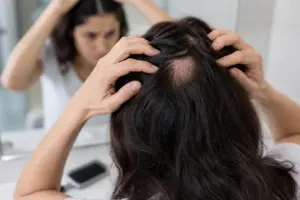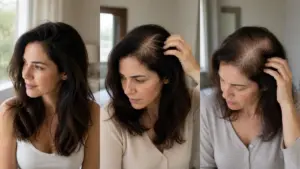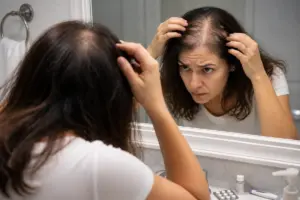
You first heard the word "alopecia" when you went to the dermatologist worried about your hair loss.
Or perhaps you yourself searched the internet trying to understand why you're losing hair.
And then you came across this medical term that seems complicated and scary.
Alopecia.
It sounds like a serious, mysterious, unsolvable disease.
But the truth is that alopecia is simply the technical term in medicine for any type of hair loss.
It's like a generic name for a huge category that includes many different types of hair loss, each with its own causes, patterns, and treatments.
Understanding what type of alopecia you have is absolutely fundamental because it completely changes the way you treat it.
What works for one type may not work, or may even worsen, for another type.
That's why doctors spend so much time examining your scalp, asking questions about when it started, what the hair loss is like, and if there are any other symptoms.
They are trying to identify exactly which category of alopecia you fall into.
And when you understand your specific type, you stop feeling lost in the dark and gain the power to make informed decisions about your treatment.
Let's completely demystify this subject, explaining the main types of alopecia in a way that anyone can understand, and most importantly, showing what can actually be done in each case.
Androgenetic Alopecia: The Most Common of All
This is the most common type of hair loss in both men and women.
In men, it's the classic baldness with receding hairlines and a bald crown.
In women, it manifests differently, with a progressive thinning mainly at the top of the head, while maintaining the frontal hairline.
The word "androgenetic" comes from "androgen" (hormones like testosterone) and "genetics" (hereditary).
This is because this condition involves both your genes and the action of hormones on the hair follicles.
It works like this: you inherit genes from your parents that make some follicles on your scalp sensitive to androgen hormones.
When these hormones interact with sensitive follicles, they cause the follicles to shrink progressively.
With each new growth cycle, the follicle gets a little smaller and produces a slightly thinner and shorter hair strand.
Over the years, the hairs become smaller and smaller until they are almost invisible, like baby down.
This type of alopecia is progressive, meaning it tends to worsen over time if left untreated.
It usually starts in one's 20s or 30s, but it can begin at any age, and gradually worsens in the following decades.
In women, it usually accelerates after menopause when estrogen levels drop.
Available treatments:
Topical minoxidil is the most established and accessible treatment, available in pharmacies in concentrations of 2 or 5 percent.
You apply the solution or foam directly to the scalp twice a day.
It works by stimulating growth and prolonging the growth phase of the hair strands.
Results appear after 4 to 6 months of continuous use.
If you stop using it, the benefits are lost.
Oral finasteride is an approved medication for men that blocks the conversion of testosterone into DHT, the most potent androgen.
In women, it can only be used after menopause due to risks to the fetus in case of pregnancy.
Oral spironolactone is an antiandrogen used in women, usually in combination with contraceptives.
It blocks the action of androgens in tissues.
Oral dutasteride is similar to finasteride but more potent, used in selected cases.
Low-intensity laser therapy, using special helmets or caps that emit red light, stimulates hair growth.
Microneedling of the scalp creates micro-lesions that stimulate growth and increase the absorption of topical treatments.
Hair transplantation is a surgical option where follicles from donor areas are transplanted to bald or thinning areas.
It works well but it's expensive and invasive.
Alopecia Areata: When the Immune System Attacks
This type is completely different from androgenetic alopecia.
Alopecia areata is an autoimmune disease, meaning that the body's defense system, which should attack invaders such as viruses and bacteria, mistakenly begins attacking its own hair follicles.
The immune system incorrectly identifies the follicles as a threat and sends defense cells to attack them.
This causes intense inflammation around the follicles, making the hair fall out quickly.
The characteristic pattern consists of circular or oval bald patches completely devoid of hair, with well-defined edges.
The bald patches appear suddenly; you don't notice gradual thinning, you simply discover an area without hair.
It could be a single small flaw the size of a coin, or it could be multiple flaws spread out.
In more severe cases, it can progress to total alopecia (loss of all hair on the scalp) or universal alopecia (loss of all body hair).
No one knows exactly why the immune system initiates this attack, but there is a genetic component.
About 20 percent of people with alopecia areata have a family member with the same condition.
Stress can be a trigger in predisposed individuals, but it is not the root cause.
Alopecia areata is unpredictable; it can regress spontaneously with hair growing back on its own, it can remain stable, or it can progress.
Available treatments:
Injectable corticosteroids applied directly to the affected areas are a first-line treatment for localized hair loss.
Monthly injections may stimulate regrowth.
Topical corticosteroids in high-potency creams or lotions applied to hairless areas.
Less effective than injections, but an option for those who cannot tolerate needles.
Oral corticosteroids are used in more extensive cases, but prolonged use has significant side effects.
Topical minoxidil may help accelerate regrowth when used in conjunction with corticosteroids.
Anthralin, a substance that causes mild scalp irritation, sometimes stimulates growth.
Topical immunotherapy with substances such as diphencyprone, which cause a controlled allergic reaction to "distract" the immune system.
Used in extensive cases.
JAK inhibitors, a new class of oral medications that block pathways in the immune system.
Baricitinib and ritlecitinib have shown promising results in recent studies and have been approved for severe alopecia areata.
Phototherapy with ultraviolet light can help in some cases.
Telogen Effluvium: The Temporary Hair Loss
This type is extremely common and usually temporary.
This occurs when a much larger number of follicles than normal simultaneously enter the resting phase of the hair cycle.
About two to three months later, all of these hairs fall out at the same time, causing intense diffuse hair loss.
Telogen effluvium is always reactive, meaning it is a response to some stressful event or situation for the body.
Common triggers include childbirth, major surgeries, prolonged high fevers, severe infections, extreme emotional stress, very restrictive diets, rapid weight loss, nutritional deficiencies, certain medications, and hormonal changes.
Hair loss is diffuse throughout the scalp, not concentrated in specific areas.
You don't develop thinning or bald patches, but the overall volume decreases.
The good news is that this type usually resolves itself within three to six months after the triggering cause is removed or resolved.
The follicles are not permanently damaged, so new hair grows normally.
Available treatments:
The primary treatment is to identify and correct the underlying cause.
If it was an iron deficiency, supplement with iron.
If it was stress, manage the stress.
If it was medication, discuss alternatives with your doctor.
Ensure adequate nutrition with sufficient protein, vitamins, and minerals.
Vitamin supplementation if deficiencies are confirmed by tests.
Topical minoxidil can be used temporarily to speed up recovery, but it is not essential.
Be patient, because recovery takes time even after the cause is corrected.
Scarring Alopecia: The Kind That Destroys Hair Follicles
This group of alopecias is more serious because it involves permanent destruction of the hair follicles, which are replaced by scar tissue.
Once the follicle is destroyed, it can no longer produce hair, and the loss is irreversible in that area.
There are several different types of scarring alopecia, caused by chronic inflammation, autoimmune diseases, infections, or dermatological conditions.
Lichen planus pilaris, frontal fibrosing alopecia, and folliculitis decalvans are some examples.
They are usually accompanied by symptoms such as burning, itching, redness, flaking, or pain in the scalp.
The affected areas become smooth, shiny, with no visible follicle openings because the follicles have been destroyed.
This type requires early diagnosis and treatment to prevent progression, because what has been lost cannot be recovered.
Available treatments:
The goal is to stop the progression and preserve the remaining follicles.
Topical or injectable corticosteroids to reduce inflammation.
Oral immunosuppressant medications such as hydroxychloroquine, methotrexate, or mycophenolate may be used in more aggressive cases.
Antibiotics if there is an infectious component.
Topical retinoids in some types.
Hair transplantation can only be considered after the disease has been completely inactive for at least one year, in order to restore already scarred areas.
Traction Alopecia: Caused by Yourself
This type occurs when the hair is repeatedly pulled forcefully for extended periods.
Very tight hairstyles such as pulled-back braids, tight buns, very tight ponytails, heavy hair extensions, poorly placed extensions, all cause constant traction on the hair.
Over time, this repeated tension damages the follicles, especially along the hairline and temples where the skin is thinner.
Initially, the hair loss is reversible if you stop doing the problematic hairstyle.
But if it continues for years, it can cause permanent damage to the follicles, resulting in irreversible loss.
Available treatments:
The most important thing is to immediately stop hairstyles that cause pulling.
Wear your hair loose or in loose hairstyles that don't pull.
Avoid heavy hair extensions and hairpieces.
Topical minoxidil may help stimulate regrowth in affected areas.
If scarring has already occurred, a hair transplant may be necessary to restore the affected areas.
Anagen Effluvium: Hair Loss During Growth
Unlike telogen effluvium, where hairs enter a resting phase and then fall out, anagen effluvium occurs when hairs are damaged during the active growth phase and fall out rapidly.
It is less common and is usually caused by severe damage to the follicles.
The most well-known cause is chemotherapy for cancer treatment.
Chemotherapy drugs attack rapidly dividing cells, including cancer cells but also cells in hair follicles.
This results in rapid and diffuse hair loss, often almost complete, during treatment.
Radiation to the scalp, heavy metal poisoning, or severe autoimmune diseases can also cause it.
Available treatments:
In cases of chemotherapy, cooling the scalp during infusions can help preserve some hair.
But usually the hair loss happens and the treatment is to wait.
The good news is that when chemotherapy ends, the follicles recover and the hair grows back, although sometimes with a different texture initially.
Minoxidil can be used after chemotherapy to accelerate regrowth.
The Importance of Correct Diagnosis
After learning about all these different types, it becomes clear why you can't simply start any treatment without knowing exactly what type of alopecia you have.
Using minoxidil for alopecia areata may help a little, but it doesn't solve the problem because it's not treating the underlying immunological cause.
Using corticosteroids for androgenetic alopecia won't work because the cause is hormonal and genetic, not inflammatory.
Treating telogen effluvium as if it were androgenetic alopecia with hormonal medications is a waste because it will resolve itself.
Therefore, a proper medical evaluation is essential.
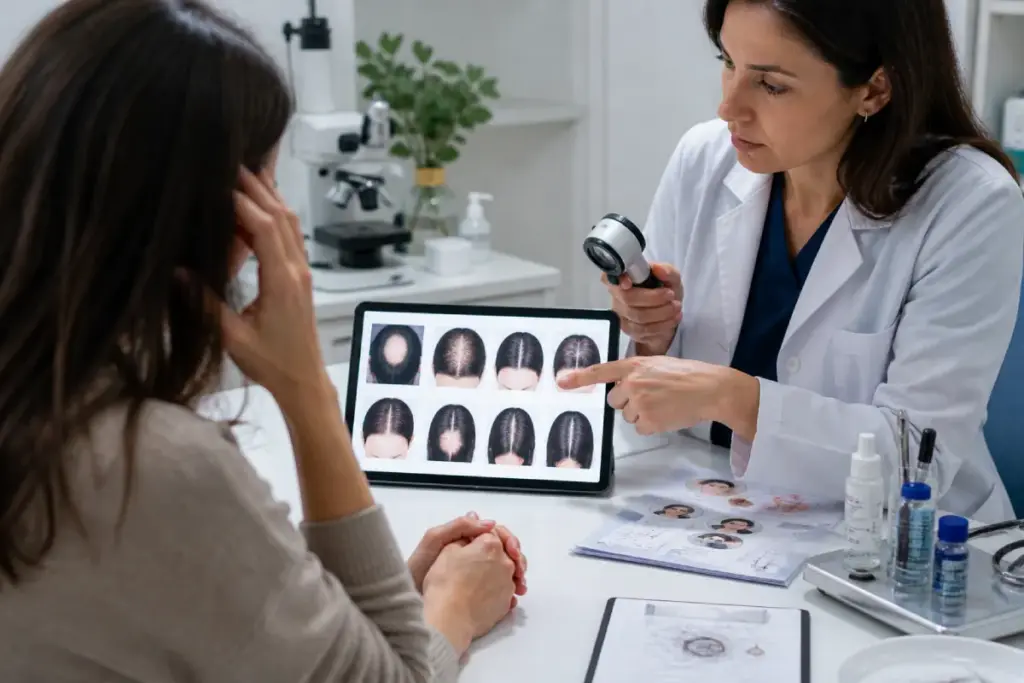
A dermatologist specializing in hair will examine your scalp, ask detailed questions about when it started, how it progressed, what symptoms you have, and your family and medical history.
You can have a trichoscopy, which is an examination of the scalp using magnifying equipment.
You can order blood tests to check hormones, nutrients, and thyroid function.
In doubtful cases, a scalp biopsy can be performed for microscopic analysis to confirm the diagnosis.
With the correct diagnosis in hand, you can follow the appropriate treatment for your specific type.
The Truth About Treatments
Here's what you need to know, very honestly, about treatments for alopecia.
There is no miracle cure that will make all lost hair grow back overnight.
Treatments take months to show results, usually between four and six months at a minimum.
Many treatments need to be maintained continuously; if you stop, the benefits are lost.
Responses vary greatly from person to person; what works wonderfully for one person may not work so well for another.
The sooner you start treatment, the better the results, because it's easier to preserve what you have than to recover what has already been lost.
But even with all these caveats, the treatments really do work.
Thousands of people experience significant improvement with the right treatments for their specific conditions.
The important thing is to have realistic expectations, patience to allow time for treatments, and persistence to maintain them.
Your hair deserves this chance, and you deserve to feel good about yourself.