Health

Your Diet May Be Stealing Your Hair

What you eat or don't eat may be causing your hair to fall out without you even knowing it.

This free test helps you find out if a lack of nutrients might be causing your hair loss. It consists of simple questions about your diet and daily habits.

Everything you eat becomes fuel and building material for your body.

When you eat protein, vitamins, minerals, and healthy fats, your body uses them to make new cells, repair tissues, produce hormones, and yes, also to make your hair grow.

Hair is made primarily of protein and needs several specific nutrients such as iron, zinc, B vitamins, and vitamin D to grow strong and healthy.

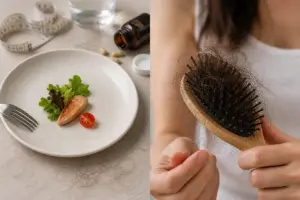
When you don't eat enough of these nutrients, whether because you're on a very restrictive diet, skipping meals, or simply not eating real food, your body has to make choices about where to use the few resources available.

And hair comes to the bottom of the priority list.

Your body sends nutrients first to your heart, lungs, brain—vital organs that keep you alive.

Hair, because it is not essential for survival, does not receive what it needs.

The follicles stop functioning properly, the hair grows thin and weak, and eventually many hairs enter the resting phase and fall out.

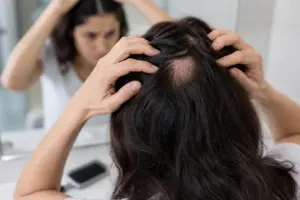
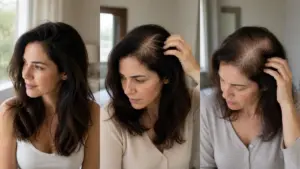
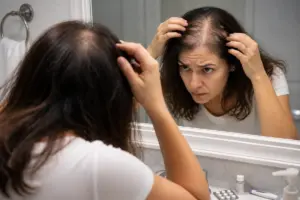
You look in the mirror and realize your hair isn't the same as it used to be.

It's thinner, less shiny, brittle, lifeless.

And with each strand that falls, a piece of your confidence goes away too.

Because when you're already putting in so much effort to lose weight, to eat healthy, to do everything right, discovering that this might be causing hair loss feels cruel.

You weren't trying to hurt yourself, you were trying to take care of yourself.

But sometimes what seems like care can be depriving your body of essential things it needs to function.

And hair is often the first visible sign that something is missing.

Discovering early on that the cause of your hair loss may be nutritional makes all the difference.

Because nutritional deficiencies are one of the easiest causes to correct when identified early.

If you discover you have an iron deficiency, for example, and start replenishing it through better diet and supplements, the hair loss usually stops within a few weeks and the hair grows back normally.

But if you let the deficiency continue for months or years without treatment, you may develop more serious health problems in addition to hair loss.

Iron deficiency causes anemia, which leaves you too tired to function.

A lack of protein compromises your immunity and muscle mass.

A lack of B vitamins can affect your nervous system.

So treating nutritional deficiencies isn't just about restoring hair, it's about taking care of your overall health.

There are several different causes of hair loss in women, and nutritional causes are very common, especially in those who follow restrictive diets.

Iron deficiency is probably the nutritional deficiency that most commonly causes hair loss in women, especially those who menstruate heavily or do not eat red meat.

Protein deficiency occurs in diets that are very low in calories or that cut out protein sources without adequately replacing them.

A lack of zinc, B vitamins, and vitamin D can also cause hair loss, and these deficiencies are common in people who eat poorly or have absorption problems in the intestine.

Besides nutritional causes, hair loss can also be caused by stress, hormonal imbalances, postpartum, autoimmune conditions, and genetics.

That's why it's important to investigate properly to find out what your specific case is.

When the body goes without the nutrients it needs for too long, the effects go far beyond just the hair.

You start to feel tired all the time even though you're getting enough sleep, because your cells lack the energy to function.

Your nails become weak and break easily, your skin loses its radiance, you may become pale, have difficulty concentrating, and feel constantly cold.

In more severe cases, deficiencies can cause serious problems such as severe anemia, osteoporosis, and neurological problems.

And all of this may be happening silently while you only notice hair loss as a visible symptom.

Therefore, when you identify and correct nutritional deficiencies, you improve not only your hair but your overall health and quality of life.

Several professionals can help you discover and treat nutritional deficiencies.

A nutritionist is a specialist in food and can assess what you eat, identify what you're lacking, and create a suitable meal plan with the nutrients you need.

He can also provide guidance on supplementation when needed.

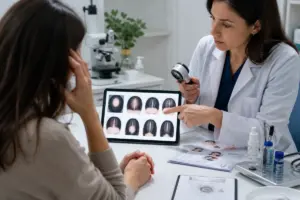
A dermatologist is a medical specialist in hair and may order blood tests to measure your iron, vitamin, and other nutrient levels, as well as investigate other possible causes of hair loss.

Your general practitioner or family doctor can give you a general health assessment, order basic tests, and refer you to specialists if necessary.

Sometimes you need a combination of these professionals working together to completely solve the problem.

Knowing exactly what is causing your hair loss determines which treatment will work.

If it's an iron deficiency, you need to replenish iron specifically through iron-rich foods like red meat or iron supplements.

Taking generic hair vitamins may not solve the problem if it's an iron deficiency.

If it's a protein deficiency, you need to increase your protein intake through your diet; simply taking vitamin supplements won't solve the problem.

If it's a vitamin D deficiency, you need moderate sun exposure and possibly vitamin D supplementation.

Each deficiency has its specific correction, and treating it correctly from the start saves you time and money.

I know it can be difficult to hear that your diet, which you thought was doing you good, may be harming you.

It can be confusing to understand that eating less isn't always eating better, and that excessive restriction can cause more harm than good.

But the body needs quality fuel to function, and hair is a sign that the body is well-nourished.

You don't need to give up on your health goals, you just need to adjust the path to get there in a way that nourishes your body instead of depleting it.

Millions of women discover that nutritional deficiencies were behind their hair loss, correct them through better diet and supplementation when necessary, and see their hair grow back.

You could be one of them.

The first step is to investigate with the right professionals, undergo the necessary tests, and then know exactly what to do.

Your body deserves to be well nourished.

Your hair deserves the nutrients it needs to grow.

And you deserve to feel good and healthy.


Frequently Asked Questions About Hair Loss and Nutrition

Can diet really cause hair loss?

Yes, very restrictive diets that cut out entire food groups or drastically reduce calories can cause hair loss because they deprive the body of essential nutrients. When you don't eat enough protein, iron, zinc, vitamins, and other nutrients, hair follicles can't function properly. The body directs the few resources available to vital organs and leaves hair as the last priority. Rapid weight-loss diets, prolonged fasting, or any very unbalanced diet can trigger hair loss a few months later.

Which nutrients are most important for hair?

The most important nutrients for healthy hair are proteins, because hair is made primarily of a protein called keratin. Iron is essential because it transports oxygen to the follicles. Zinc is involved in hair growth and repair. B vitamins, especially biotin and B12, are important for the hair cycle. Vitamin D influences follicle growth. And healthy fats keep the scalp and hair hydrated. When any of these are lacking, hair can suffer.

How long does it take for hair to improve after correcting diet?

When you start eating healthier or taking supplements to correct deficiencies, hair loss usually stops within two to four weeks. But seeing visibly fuller hair takes longer because the strands need to grow. Since hair grows about one centimeter per month, it can take six months to a year to regain the volume you had before. That's why it's important to be patient and maintain a proper diet even when you don't yet see visual results.

Do vitamin supplements for hair work?

Supplements work when you have a proven deficiency of those specific nutrients. If you are iron deficient and take an iron supplement, it will help. But if your deficiency is due to stress or hormones and you take vitamins, it probably won't solve the problem. Therefore, it's ideal to have blood tests done before spending money on supplements, to find out if you really need them and which ones specifically. Taking megadoses of vitamins unnecessarily can even be harmful, so always seek professional guidance.

Are vegetarians at higher risk of falls due to nutritional deficiencies?

Vegetarians and vegans may be at higher risk of certain deficiencies if they don't plan their diet well. Iron deficiency is common because plant-based iron is absorbed with more difficulty than iron from meat. Vitamin B12 is naturally found only in animal-based foods, so vegans need mandatory supplementation. Complete protein also requires attention to properly combining plant-based sources. But with good planning, supplementation when necessary, and nutritional monitoring, it's entirely possible to have healthy hair as a vegetarian or vegan.


This content is for educational and informational purposes only and does not replace consultation with a doctor or qualified healthcare professional. Nutritional deficiencies due to restrictive diets or inadequate nutrition cause reversible hair loss. Proper nutritional correction restores healthy hair growth.

About the author

Malu Oliveira

I write about current events and technology, exploring trends and innovations. My passion is communicating complex ideas in an accessible and engaging way.