
You're doing everything right.
She cut out sugar, eliminated carbohydrates, is following that diet that everyone swears works, and finally managed to lose a few pounds.
Or maybe you're simply so busy, so tired, so short on time, that you've started skipping meals, eating whatever's quick, and basically living on coffee and snacks.
Or perhaps you became vegetarian or vegan out of conviction, for health reasons, for ethical reasons, and are genuinely trying to do things right.
But then, a few months later, you realize something alarming.
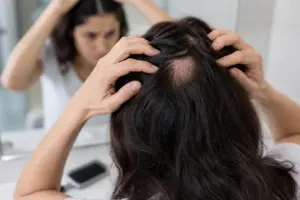
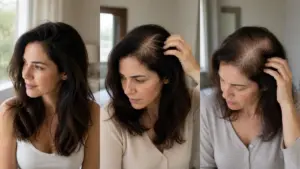
Your hair is falling out much more than usual.
Strands and more strands of hair in the drain, on the brush, on the pillow, scattered all over the house.
The volume has visibly decreased, the hair looks lifeless, dull, and brittle.
And along with that, you might be feeling tired all the time, your nails are breaking easily, and your skin doesn't have that healthy look it used to.
You're confused because you thought you were taking better care of yourself, but your body seems to be screaming that something is wrong.
And he really is.
Your body is sending clear signals that it is not receiving the essential nutrients it needs to function properly.
And hair, because it is not vital for survival, is one of the first places where this deficiency manifests itself.
The good news is that hair loss caused by nutritional deficiencies is completely reversible when you identify what's missing and correct the problem.
Let's understand exactly which nutrients your hair needs, how to identify if you have deficiencies, and what to do to reverse the situation and restore your hair.
Why Hair Is the First to Suffer
Before discussing specific nutrients, you need to understand why hair reacts so quickly when something important is missing from your diet.
Your body works with an intelligent system of priorities.
When nutritional resources are limited, when you are not consuming or absorbing enough nutrients, the body needs to make choices about where to distribute what is available.
And these choices follow a very clear hierarchy of importance for survival.
First in line: vital organs such as the heart, lungs, brain, kidneys, and liver.
These organs keep you alive, so they always receive absolute priority.
Second in line: essential systems such as blood cell production, the immune system, and the repair of critical tissues.
Hair? It's way down at the bottom of the priority list.
Hair is not essential for keeping you breathing, your heart beating, or your brain functioning.
Therefore, when nutrients are lacking, the body simply diverts resources from the hair to more important functions.
Hair follicles are metabolically extremely active structures.
They are constantly producing new cells, dividing rapidly to make the hair strands grow.
This accelerated growth process requires a lot of energy and many specific nutrients.
Proteins, vitamins, minerals—everything needs to be available in adequate amounts.
When it is not present, the follicles are unable to maintain the production rate.
They slow down, stop functioning properly, and eventually push the wires prematurely into the resting phase.
A few months later, all those hairs that had gone into a resting phase fall out at once, and you notice increased hair loss.
That's why hair acts as a thermometer for your nutritional health.
If it's falling apart, brittle, lifeless, that usually means it's lacking important nutrients, and your body is telling you this in the only way it can.
The Nutrients Your Hair Can't Live Without
Let's talk specifically about the most critical nutrients for hair health and what happens when each of them is lacking.
Proteins: The Foundation of Hair
Hair is made up primarily of a protein called keratin.
To produce keratin, your body needs amino acids, which are the building blocks of proteins, and these amino acids come from the digestion of the proteins you eat.
If you don't consume enough protein, your body simply doesn't have the raw materials to build hair strands.
This is especially common in people who follow very restrictive calorie diets, who completely eliminate animal protein without adequate replacement, or who regularly skip meals.
When protein is lacking, the hair produced becomes thin, weak, brittle, grows slowly, and the body may put more follicles into the resting phase to conserve resources.
You need protein every day, at every meal, because the body doesn't store protein like it stores fat.
Sources include meats, poultry, fish, eggs, dairy products, legumes such as beans and lentils, soy and soy products, nuts and seeds.
Iron: The Carrier of Life
Iron is absolutely crucial for hair growth, and iron deficiency is probably the most common nutritional cause of hair loss, especially in women.
Iron is part of hemoglobin, the molecule inside red blood cells that carries oxygen from the lungs to all the body's tissues.
Hair follicles need a lot of oxygen to function because they are cells that divide rapidly.
When iron is lacking, less hemoglobin is produced, less oxygen reaches the follicles, and they are unable to function properly.
This results in hair that grows more slowly, is thinner, and is more prone to falling out.
Iron deficiency can exist long before it causes clinically detectable anemia.
Your ferritin levels, which measure the body's iron stores, may be low even with an apparently normal blood count.
Even these low levels are enough to affect the hair.
Women who menstruate are at constant risk because they regularly lose iron through menstrual blood.
If menstruation is heavy, the risk is even greater.
Pregnant and breastfeeding women need significantly more iron because they are meeting not only their own needs but also those of their baby.
Vegetarians and vegans need to pay special attention because there are two forms of iron in the diet.
Heme iron, which comes from animal sources such as red meat, is easily absorbed by the intestine.
Non-heme iron, which comes from plant sources such as beans, lentils, and spinach, is absorbed with much more difficulty.
Therefore, vegetarians need to consume significantly more total iron to absorb adequate amounts, and often require supplementation.
Signs of iron deficiency, in addition to hair loss, include excessive fatigue, paleness, brittle nails, shortness of breath with minimal exertion, and cravings for unusual foods like ice.
Zinc: The Silent Regulator
Zinc is a mineral that participates in hundreds of chemical reactions in the body, including those essential for tissue growth and repair.
Hair follicles, with their high rate of cell division, require abundant zinc.
Zinc deficiency can cause diffuse hair loss, brittle hair, very slow growth, and sometimes even changes in hair texture.
Rich sources include meats, seafood, especially oysters, nuts, seeds, whole grains, and legumes.
Very restrictive diets, poor intestinal absorption, or excessive alcohol consumption can lead to deficiency.
B Complex Vitamins: The Support Team
B vitamins work together to maintain healthy hair.
Biotin, also known as vitamin B7, became famous as a hair supplement, although true biotin deficiency is rare.
It helps in the production of keratin and can improve the structure of the hair strands.
Folic acid, vitamin B9, is important for the production of red blood cells and for cell division.
Deficiency can contribute to hair loss and slow growth.
Vitamin B12 is crucial for the production of blood cells and for nerve function.
It is found naturally only in foods of animal origin, so strict vegetarians and vegans need mandatory supplementation.
Vitamin B12 deficiency can cause not only hair loss but also anemia and serious neurological problems.
People with intestinal absorption problems, the elderly, and those using certain medications may also develop deficiencies even when eating properly.
Vitamin D: The Forgotten Hormone
Vitamin D is technically a hormone that we produce in our skin when exposed to sunlight.
It plays an important role in the hair follicle growth cycle.
Vitamin D deficiency is extremely common, especially in people who live far from the equator, work indoors, constantly use sunscreen, or have very dark skin.
Studies suggest a link between low vitamin D levels and alopecia areata, and there is also evidence that it influences the normal hair growth cycle.
Food sources are limited, including oily fish, egg yolks, and fortified foods.
Moderate sun exposure and supplementation are often necessary.
Essential Fatty Acids: Hydration from Within
Omega-3 fatty acids help maintain a healthy scalp and keep hair hydrated from the inside out.
Extremely low-fat diets can lead to dry, brittle hair and a flaky scalp.
Sources include oily fish such as salmon, walnuts, flax and chia seeds, and avocado.
How to Know If You Have Disabilities
Identifying nutritional deficiencies is not something you can do on your own just by observing symptoms, because many deficiencies cause similar symptoms.
The only reliable way is through specific blood tests.
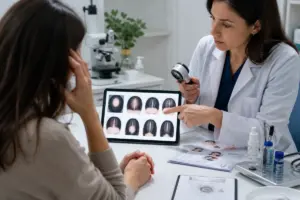
If you are experiencing hair loss and suspect it may be nutritionally related, especially if you also have fatigue, weak nails, paleness, or if your diet is very restrictive, it's worth having a basic check-up.
Important tests include a complete blood count to check for anemia, ferritin to measure iron stores, vitamin B12, vitamin D, zinc, and thyroid function tests, as thyroid problems often go hand in hand with nutritional deficiencies.
Based on the results, a doctor or nutritionist can advise you on exactly what supplements you need and in what doses.
Don't start taking a bunch of supplements on your own before getting tested, because some vitamins in excess can also cause problems, and you'll be shooting in the dark without knowing what you're really lacking.
Risk Profiles: Who is Most Likely to Develop Disabilities
Some situations and profiles have an increased risk of developing nutritional deficiencies that affect the hair.
Women with heavy menstrual bleeding lose a lot of iron each month and may not be able to replenish it adequately through diet alone.
Pregnant and breastfeeding women have greatly increased nutritional needs because they are feeding two organisms.
Vegetarians and vegans need careful planning and frequent supplementation to avoid deficiencies in B12, iron, zinc, and omega-3.
People who follow very restrictive calorie diets or who eliminate entire food groups are at high risk.
Extreme low-carb diets, diets that cut out all fats, very prolonged intermittent fasting without attention to nutritional quality—all of these can create deficiencies.
People with eating disorders such as anorexia or bulimia almost always develop multiple disabilities due to malnutrition.
Those who have undergone bariatric surgery may have difficulty absorbing certain nutrients even when eating properly.
People with bowel diseases such as celiac disease, Crohn's disease, or ulcerative colitis may have chronic malabsorption.
Older adults often have reduced absorption and decreased appetite, leading to multiple deficiencies.
Chronic use of certain medications can interfere with the absorption or metabolism of nutrients.
If you fit any of these profiles, extra attention to nutrition is essential.
How to Reverse Nutritional Loss
The good news is that when hair loss is caused by nutritional deficiencies, it is completely reversible with proper correction.
First step: identify through tests which nutrients are deficient.
Second step: correct the deficiencies through dietary changes and supplementation when necessary.
If you have an iron deficiency, you may need iron supplements for several months until your iron levels return to normal.
Take iron separately from coffee, tea, and dairy products, which impair absorption, and combine it with vitamin C, which improves absorption.
If it's B12 deficiency, oral supplementation or injections are used depending on the severity.
If it's vitamin D, supplement in doses that your doctor determines based on your current level.
If it's protein, consciously increase your intake at every meal.
Third step: maintain a balanced and nutritious diet in the long term to prevent new deficiencies.
This means eating quality proteins, a variety of colorful vegetables, fruits, healthy fats, and whole grains.
Don't skip meals, and don't go on crazy diets that eliminate entire food groups.
If you are vegetarian or vegan, work with a nutritionist to plan accordingly.
How long until I see improvement?
The decline usually stops two to four weeks after nutritional levels begin to normalize.
Visual recovery of hair density takes longer because the hair needs to grow.
Since hair grows about one centimeter per month, it can take six months to a year to fully regain its volume.
But the active shedding stops well before that, so you'll notice you're no longer losing excessive hair long before you see the volume return.
The Message Your Body Is Sending
Hair loss due to nutritional deficiencies isn't just about hair.
It's your body telling you that something fundamental is missing, that you're not adequately nourishing the organism that carries you through life every day.
If your hair is being affected, other systems are also suffering; you just can't see it yet.
Iron deficiency affects your energy, cognitive ability, and immunity.
Vitamin B12 deficiency can cause irreversible neurological damage if left untreated.
Protein deficiency compromises muscle function, immunity, and wound healing.
So when you notice hair loss, don't ignore it as if it were just a cosmetic issue.
Investigate, find out what's missing, fix it.
Your body deserves to be properly nourished.
You deserve to have energy, vitality, and health.
And your hair will grow strong and healthy when you give your body everything it needs to function.
Food is not the enemy; it is not something to be feared or drastically restricted.
It's fuel, it's medicine, it's self-care.
Eat well, and your body, including your hair, will thank you.