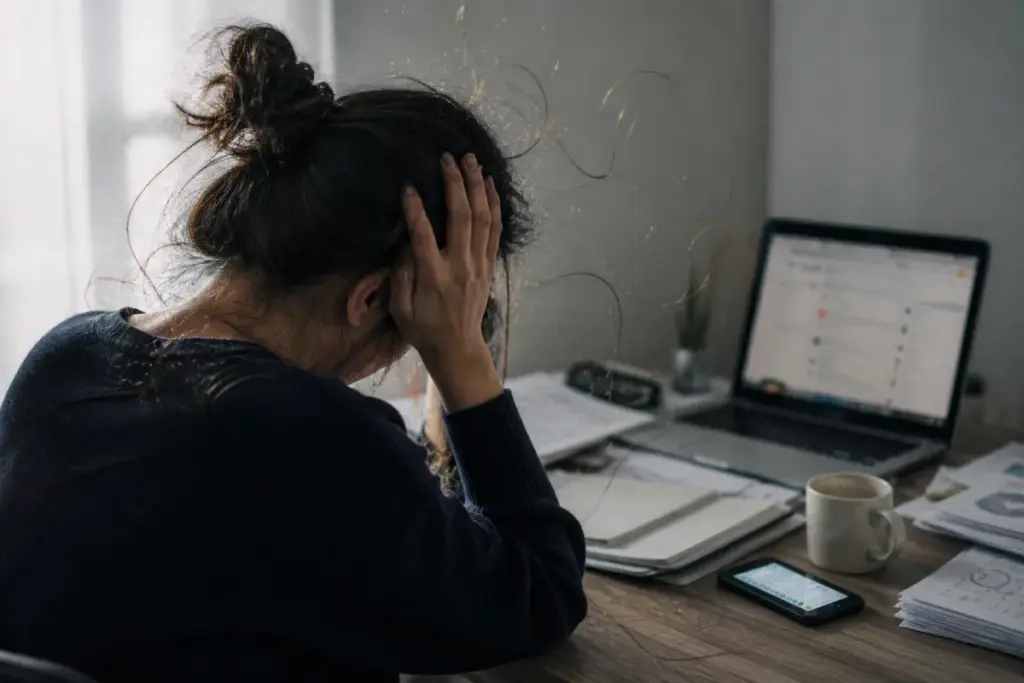
You are going through a very difficult period in your life.
Perhaps it's a job that's draining all your energy, a relationship that's causing you suffering, financial problems that are keeping you awake at night, or a combination of several heavy things happening at the same time.
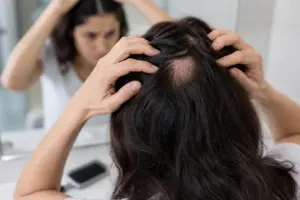
And in the midst of all this, you started noticing something frightening: your hair is falling out much more than usual.
Every time you run your hand through your hair, several strands of hair get caught between your fingers.
The shower drain gets clogged with hair, the brush looks like it's going to overflow, and you find strands of hair scattered all over the house.
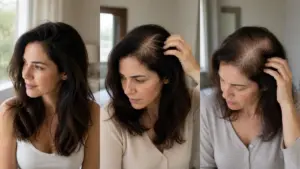
You look in the mirror and realize that your hair is visibly thinner, less voluminous, and what was already difficult becomes even more distressing.
Because now, in addition to dealing with all the problems that were already stressing you out, you have this extra worry: will I go bald because of the stress?
The short answer is no, you will not go bald.
Yes, stress can indeed cause hair loss, and often does.
The good news is that hair loss due to stress is almost always temporary and completely reversible when you manage to control what is causing all that tension.
Let's understand exactly how stress affects your hair, why this happens, and most importantly, what you can do right now to stop this process and restore your hair.
How Stress Attacks Your Hair
To understand how to stop hair loss, you first need to understand what stress is doing to your hair follicles.
When you go through very stressful situations, your body activates an emergency system that has existed since the Stone Age.
This system was developed to help our ancestors survive immediate physical threats, such as fleeing from a dangerous animal.
The body releases a cascade of stress hormones, primarily cortisol and adrenaline.
These hormones make your heart beat faster, increase your blood pressure, send sugar to your muscles and brain, and basically prepare you for fight or flight.
The problem is that in the modern world, our stressors aren't animals we can run away from and that's it, danger is over.
These are situations that last for weeks, months, or even years: an abusive boss, a toxic relationship, seemingly endless debt, caring for someone who is ill, job insecurity.
So your body stays in this constant state of alert, releasing stress hormones day after day without stopping.
And here's what happens to your hair when this becomes a routine.
Elevated cortisol levels cause your body to enter energy-saving mode.
The body decides that it needs to prioritize functions essential for immediate survival: heart, lungs, brain, muscles.
And hair growth is definitely not essential when your body thinks you're in constant danger.
So cortisol pushes a much larger number of hair follicles into the resting phase ahead of time.
Typically, about 85 to 90 percent of your hair strands are actively growing at any given time, and only 10 to 15 percent are resting.
But when stress kicks in, that ratio changes drastically.
Many more follicles enter a resting phase simultaneously, as if the body were saying: we can't spend energy growing hair right now, we're in crisis.
These follicles remain dormant for about three months, and then all the hairs fall out at the same time.
Therefore, there is a delay between the moment of intense stress and the visible fall.
You went through something very difficult in January, but it's only in April that you start to notice the increased decline.
Many people don't make that temporal connection and don't understand why they are losing hair.
This condition has a name: stress-induced telogen effluvium.
It is one of the most common forms of hair loss, especially in women.
In addition to this direct hormonal mechanism, stress affects hair in other ways as well.
People who are very stressed often sleep poorly, and inadequate sleep impairs hair growth because it is during deep sleep that the body performs cellular repairs and renewals.
Stress disrupts eating habits; some people lose their appetite completely, while others eat compulsively but choose foods that are low in nutrients.
Both patterns can create deficiencies that affect the follicles.
Chronic stress also suppresses the immune system in complex ways, and in some people it can even trigger autoimmune conditions such as alopecia areata.
Some people develop stress-related compulsive behaviors, such as pulling out their own hair, a condition called trichotillomania.
So stress doesn't attack your hair in just one way, but in several at the same time.
Identifying if Stress Is Really the Cause
Before you begin treatment, you need to be sure that stress is actually the cause of your hair loss.
There are some signs that indicate you are dealing with stress-related telogen effluvium.
First, the decline began two to three months after a period of very intense stress or a specific stressful event.
It could have been the loss of a loved one, a divorce, losing a job, surgery, a radical life change, or any situation that was emotionally or physically very difficult.
Secondly, the hair loss is diffuse, meaning the strands fall out scattered all over the head, not in specific areas.
You don't develop round bald patches, nor do you lose hair only on one side or only in the front.
It is a general rarefaction of volume.
Third, when you gently pull a few strands, several come out easily, more than used to happen before.
In the bedroom, you find a lot of hair on the pillow in the morning, in the shower drain, on the brush, scattered around the house.
And fifth, you can make that temporal connection: there was a period of intense stress, and a few months later the decline began.
If these signs match your situation, it's very likely that stress is the main factor.
However, it's important to rule out other causes as well, especially if the hair loss is very intense or accompanied by other symptoms.
Thyroid problems, severe nutritional deficiencies, hormonal imbalances, certain medications—all of these can also cause hair loss.
If you have doubts, if the hair loss seems excessive, or if it doesn't improve even when managing stress, it's worth getting basic blood tests to check your thyroid, iron, vitamins, and hormones.
But if the pattern is clearly one of telogen effluvium linked to identifiable stress, you can start taking action immediately.
How to Stop the Fall: Immediate Strategies
Here's the truth no one wants to hear but you need to know: to stop hair loss caused by stress, you need to stop the stress.
There is no magic shampoo, miracle supplement, or topical treatment that will solve the problem as long as the source of stress continues to attack your body.
You need to get to the root of the issue, literally.
But I know that "stop stressing" is completely useless advice when you're in the middle of a storm.
You didn't choose to be stressed; life's circumstances are just difficult.
So let's talk about real, practical strategies that work even when you can't simply eliminate the source of stress.
First, identify what specifically is causing you the most stress and see what is genuinely within your control to change.
Sometimes you can't change the situation, but you can change how you respond to it.
If the job is unbearable and you can't leave right now, are there any boundaries you can set?
Can you turn off notifications after a certain time, can you delegate some tasks, can you say no to extra demands?
If a relationship is draining you, you could seek couples or individual therapy to develop better communication and boundary-setting skills.
If you're facing financial problems, could you seek financial advice or create a realistic plan that gives you some sense of control?
The idea is not to solve everything at once, because that would be impossible and would only increase stress.
The idea is to identify small, concrete actions that give you back some sense of agency.
Second, prioritize sleep as if your life depended on it, because in fact, your health does.
When you don't sleep well, cortisol levels get even higher, creating a vicious cycle.
Establish a consistent sleep routine, going to bed and waking up at the same time every day, including weekends.
Create a relaxing bedtime ritual: a warm bath, reading, gentle stretching, meditation—whatever works for you.
Remove screens from the bedroom, make the room dark and cool, and invest in a comfortable mattress and pillow if possible.
If you still can't sleep, seek medical help because chronic inadequate sleep harms absolutely everything in your body, including your hair.
Third, move your body every day.
Physical exercise is one of the most powerful tools available for reducing cortisol and releasing endorphins, which are the hormones of well-being.
It doesn't have to be heavy gym workouts or marathon running.
Even a thirty-minute walk makes a significant difference.
Yoga, dancing, swimming, cycling, any movement that you genuinely enjoy and can maintain.
What matters is consistency, not intensity.
Regular exercise improves sleep, reduces anxiety, improves mood, and sends signals to the body that everything is okay, there is no danger, and we can return to normal functions like growing hair.
Fourth, learn and practice techniques for regulating the nervous system.
Deep, conscious breathing is incredibly powerful.
When you breathe deeply and slowly, you literally switch off the fight-or-flight system and activate the rest-and-recovery system.
Try the 4-7-8 technique: inhale counting to four, hold counting to seven, exhale counting to eight.
Do this five times whenever you feel your stress rising.
Meditation and mindfulness also have solid scientific evidence that they reduce cortisol.
There are free apps with guided meditations of five or ten minutes; you don't need to become a Buddhist monk.
You just need to create small pauses in your day where you step out of autopilot and reconnect with the present.
Fifth, take care of your diet even when you don't feel like it.
When we're stressed, it's tempting to skip meals or live on coffee and junk food.
But your body needs quality fuel to function, and hair follicles need specific nutrients.
Make sure you have enough protein at every meal because hair is made of protein.
Eat a variety of colorful vegetables to get vitamins and minerals.
Don't skip meals because that puts even more stress on your body.
If you're really having trouble eating properly because of anxiety, consider a basic multivitamin supplement and talk to a doctor about specific supplementation.
Sixth, and this is crucial: seek professional support for your mental health.
Therapy is not a luxury, it's a health tool.
A psychologist can help you develop healthy coping strategies, process difficult situations, and identify patterns that increase your stress.
Cognitive behavioral therapy is especially effective for anxiety and stress.
If stress has developed into severe anxiety or depression, a psychiatrist can assess whether medication would be appropriate.
There is absolutely no shame in needing professional help; in fact, seeking support is a sign of strength and self-care.
Seventh, build and maintain social connections even when you have no energy.
Isolation worsens stress exponentially.
You don't have to go to parties if you don't feel like it, but staying in touch with people who make you feel good, who listen to you, who support you, makes a real difference.
A conversation with a dear friend, lunch with your mother, an online support group—anything that reminds you that you're not alone.
Eighth, do things that bring you pleasure, even if they seem silly compared to your problems.
Reading a book, watching your favorite series, taking care of plants, doing crafts, cooking, listening to music, spending time with pets.
Small moments of joy and pleasure help to balance cortisol.
You don't have to be unhappy one hundred percent of the time just because you're going through a difficult time.
Treatments That Can Help While Stress Decreases
While you're working on stress management strategies, there are a few things that can specifically help with your hair.
Topical minoxidil, sold in pharmacies as Rogaine or generic versions, may help stimulate hair growth.
It works by increasing blood flow to the follicles and prolonging the hair growth phase.
It doesn't address the root cause, which is stress, but it can speed up recovery while you work on that.
Talk to a dermatologist about using minoxidil during the recovery period.
Specific hair supplements can help if you have nutritional deficiencies.
Biotin, B vitamins, iron, zinc, and vitamin D are the most common.
But don't start taking a bunch of supplements without guidance.
First, get blood tests to identify if there are any deficiencies, because an excess of some vitamins can also be harmful.
Treatments such as scalp microneedling, low-level laser therapy, and applications of stimulating peptides may help in more persistent cases.
A trichologist or dermatologist can assess whether these treatments are right for you.
Be very gentle with your hair during this period.
Avoid harsh chemicals, excessive heat, and very tight hairstyles.
Use gentle products, avoid washing with very hot water, and do not rub your hair with a towel.
Treat your hair as if it were precious and fragile, because right now it really is more vulnerable.
How long until I see improvement?
This is always the most important question: when will this stop?
The answer depends on how well you can manage stress.
If the source of the stress was a specific event that has already passed, such as surgery or a divorce that has already been finalized, the decline usually stops on its own within three to six months.
If stress is chronic and ongoing, the decline may persist as long as stress levels remain high.
But as soon as you start implementing effective stress management strategies, your body begins to calm down.
As cortisol levels begin to decrease, the nervous system starts to regulate itself, and the follicles receive the signal that they can return to work.
You may start to notice less hair loss two to four weeks after implementing consistent changes in stress management.
Full hair density recovery takes longer because the hair needs to grow.
Since hair grows about one centimeter per month, it can take six months to a year for you to visually regain the volume you had before.
But the active decline stops well before that.
Be patient with yourself during this process.
The Truth That Will Set You Free
Here's what you most need to understand: hair loss due to stress is your body screaming that something needs to change.
It's not punishment, it's not your fault, it's not weakness.
It's a warning sign, an alert system telling you that you are operating beyond your sustainable capacity.
And yes, it's scary to see your hair falling out.
But perhaps this is the thing that will finally force you to prioritize your well-being in a way you weren't doing before.
You can't keep sacrificing yourself endlessly without consequences.
His body has limits, and he's showing that in the only way he can.
So instead of just trying to stop the hair loss, use this as a call to honestly examine your life.
What needs to change?
What boundaries do you need to set?
What kind of help do you need to ask for?
What situations do you need to get out of, even if it's difficult?
Your hair will grow back when you create living conditions that allow your body to feel safe again.
And when he returns, it will be a reminder that you survived a difficult period and had the courage to make necessary changes.
Take care of yourself with the same dedication you give to everyone around you.
You deserve to live a life that doesn't make you sick.
And your hair deserves to grow on a body that is rested, nourished, and at peace.